One Platform for AI Image, Video, and Audio Detection
AI-generated content is no longer just images. In the past two years, generative AI has expanded to video (Sora, Runway, Kling, Veo), music, and voice (voice cloning, text-to-speech). The content flooding platforms today is multi-modal and detection needs to be too.
Yet most organizations still rely on fragmented detection setups: one vendor for images, another for video, maybe a research tool for audio. This patchwork approach creates gaps, increases operational complexity, and slows down response times. Sightengine offers a different approach: a single platform for AI detection across images, video, and audio.
The multi-modal AI threat
Each modality carries its own risks:
- AI images remain the most common form of synthetic content. They are used in misinformation, fraud (fake profiles, fake products), and intellectual property violations. With generators like Nano Banana, Midjourney, GPT-Image and Grok producing near-photorealistic output, visual inspection alone is no longer reliable.
- AI video is the fastest-growing frontier. Tools like Sora, Runway, Kling, Veo, and Pika can produce realistic short-form video from text prompts. AI-generated video is already appearing in news manipulation, social engineering, and fraudulent advertising.
- AI music is disrupting creative platforms. AI-generated tracks can mimic specific artists or genres, raising concerns about copyright infringement, misattribution, and platform integrity.
- AI voice and speech (including voice cloning and text-to-speech) enable impersonation at scale. From CEO fraud calls to fake celebrity endorsements, synthetic voice is a growing vector for social engineering attacks.
Platforms that only detect AI-generated images are blind to threats arriving through other modalities. And as AI generators become more accessible, the volume of synthetic content across all modalities will only increase.
The cost of fragmented detection
Many organizations have attempted to address multi-modal AI content by assembling a patchwork of specialized vendors. This approach introduces several problems:
- Multiple integrations. Each vendor has its own API, authentication, response format, and rate limits. Engineering teams spend time building and maintaining connectors instead of focusing on core product work.
- Inconsistent scoring. Different vendors use different scoring scales, thresholds, and confidence calibrations. Comparing an image detection score from one vendor with a video detection score from another is unreliable.
- Operational overhead. Multiple dashboards, multiple billing relationships, multiple support channels. Every additional vendor multiplies the operational burden on T&S teams.
- Coverage gaps. Some vendors specialize in one modality and offer limited or no coverage for others. Gaps between tools become blind spots where synthetic content slips through undetected.
Sightengine's unified approach
Sightengine provides AI detection across all major content modalities through a single platform:
AI image detection
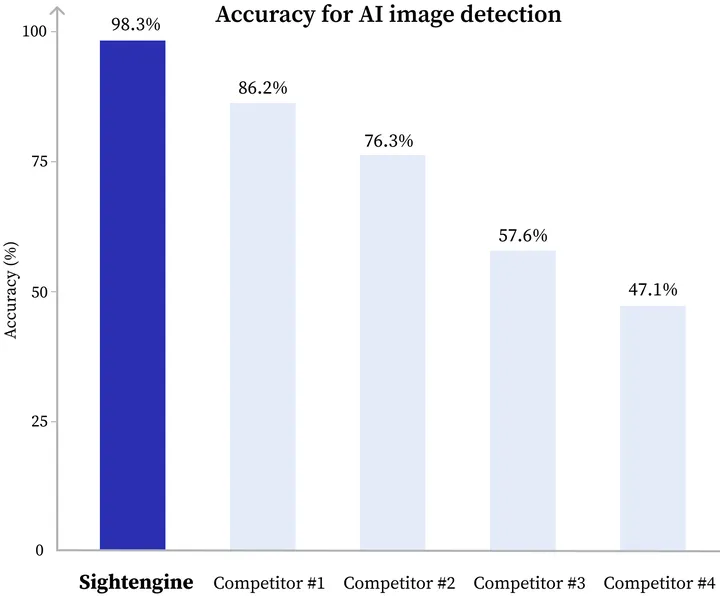
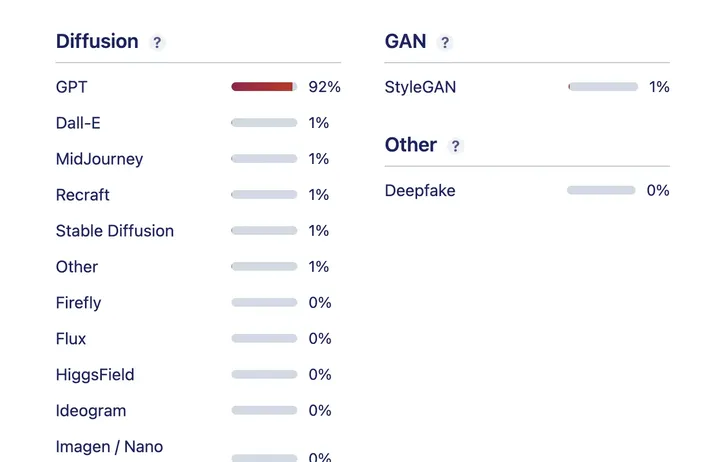
Detect AI-generated images across 20+ generators including DALL-E, Stable Diffusion, Midjourney, Flux, GPT-4o, Ideogram, Firefly, and many more. The system returns per-generator confidence scores with version-level granularity, giving analysts full visibility into what created the content. Sightengine ranked #1 in an independent benchmark with 98.3% accuracy on 80,000 images.
AI video detection
Analyze videos frame by frame to detect AI-generated content from generators like Sora, Veo, Runway, Kling, Pika, Wan, and Midjourney. The frame-level analysis means you can pinpoint exactly which segments of a video are synthetic. This is critical for videos that mix real and AI-generated footage.
AI music detection
Detect AI-generated music tracks. As generative music tools become more capable and widespread, this capability helps platforms protect creator rights and maintain catalog integrity.
AI audio and speech detection
Detection of synthetic speech, including text-to-speech and voice cloning, is in active development and will extend Sightengine's coverage to the full spectrum of AI-generated audio content.
All of these capabilities are accessible through a single API with consistent authentication, response formats, and scoring scales. They are also available through Sightengine Detect, our no-code dashboard for non-technical users.
Built on years of real-time content analysis
Sightengine's AI detection capabilities didn't appear overnight. They are built on top of an infrastructure that has been processing content at scale for years, originally for image and video moderation.
This means the platform was designed from the start for the demands of real-world deployment:
- Scale. Millions of items processed per month, with the ability to handle traffic spikes without degradation.
- Speed. Real-time results, including on video and live streams. Sightengine has supported live-stream analysis for years, processing content as it is being broadcast, not after the fact.
- Privacy. No human reviewers in the loop. Content is analyzed by models and never stored beyond the processing window.
- Reliability. Enterprise-grade uptime and support, with the infrastructure to back SLAs for mission-critical applications.
This operational maturity is a key differentiator. Building accurate AI detection models is one challenge; running them reliably at enterprise scale across multiple modalities is another. Sightengine does both.
One platform, complete coverage
The value of a unified multi-modal platform compounds over time:
- Consistent policies. Define your AI content policies once and apply them across all modalities with the same scoring framework.
- Correlated analysis. When a piece of content includes both video and audio, analyzing both through the same platform enables correlated insights, for example detecting that the video is authentic but the audio track is AI-generated.
- Simplified operations. One integration to build, one dashboard to monitor, one vendor to manage. Your T&S team can focus on making decisions, not wrangling tools.
- Future-proof. As new modalities and generators emerge, they are added to the same platform. No new vendor evaluations or integrations required.
How to get started
Whether you need API-level integration for automated pipelines or a visual dashboard for manual investigations, Sightengine has you covered.
- Explore our AI image detection, AI video detection and AI music detection
- See our API documentation
- Try Sightengine Detect for no-code analysis of images, video, and audio
Read more
Sightengine Ranks #1 in AI-Media Detection Accuracy: Insights from an Independent Benchmark
Learn how Sightengine performed in an independent AI-media detection benchmark, outperforming competitors with advanced methodologies.
Beyond Binary: Why Per-Generator AI Detection Matters
Learn why per-generator confidence scores across 20+ AI generators give you the granularity that binary AI detection can't.