
- AI Content Detection
- AI Image DetectionDetect AI-generated images.
- Deepfake DetectionIdentify face swaps and AI manipulation.
- AI Video DetectionSpot AI-generated video content.
- AI Speech DetectionDetect AI-generated speech.
- AI Music DetectionDetect AI-generated music.
- Moderation
- Image Moderation150+ moderation classes for your images.
- Video ModerationModerate and filter videos and live streams.
- OCR & QR ModerationModerate text and QR codes present in images and videos.
- Text ModerationDetect and filter unwanted text-based content.
- Audio ModerationModerate and filter audio content.
- Visual Search
- Image & Video SearchFind duplicates and similar content.
- People & Identity
- Profile image validationValidate images based on face visibility, quality, filters and more.
- Age group estimationImplement age group verifications.
- Face Liveness DetectionDetect spoofing attempts and presentation attacks.
- Image Analysis & OCR
- OCRExtract text from images and videos at scale.
- Image QualityAssess technical and aesthetical quality.
- Learn
- Knowledge CenterNews, research and guides
- API DocumentationLearn to use the API and discover all features
- FAQAnswers to common questions on the API and plans.
- Free tools
- C2PA CheckerVerify Content Credentials. Your image stays in your browser.
- EXIF & Metadata ViewerInspect hidden image metadata. Your image stays in your browser.
- AI or Not gameCan you tell real images, videos and music from AI?
Sightengine wins the Video Deepfake Detection Challenge
On this page
Sightengine ranked first in the deepfake video detection challenge organized by the French Ministry of Defence, well ahead of the other participants and of the commercial solutions tested, including Resemble AI, Hive and Reality Defender.
TLDR:
- Clear lead in manipulated video detection: an overall score of 0.978 (AUC-ROC), against 0.925 for second place (see chart)
- Excellent scores on face swaps (0.996), fully AI-generated videos (0.995), lip-sync (0.991) and AI avatars (0.977), as well as 0.900 on localized AI edits (see chart)
The challenge: 40,000 unseen videos
The French Ministry of Defence (COMCYBER, AID, AMIAD) organized a challenge to benchmark AI and deepfake detection solutions, open to both industry and academic participants.
The challenge consisted of a set of 40,000 videos, half of which were real, and half of which contained AI manipulations. These manipulations covered a wide range of techniques, forcing models to detect not only fully AI-generated videos, but also AI manipulations and edits applied to real footage:
- lip-syncing with or without voice cloning (e.g. changing the movement of a person's lips to make them say something different)
- face identity swaps (changing the identity of a person in a clip)
- localized AI edits (removing an object from a scene, adding an object, changing characteristics of a scene, etc.)
- AI generation (generating new frames or clips)
To reflect real-world situations and variability, the set was deliberately diverse:
- 47 platforms and generators, both open and closed-source
- short clips of 5 to 10 seconds, with or without audio
- 50 languages
- 12 resolutions, from 480x640 to 1920x1080
The dataset was made even harder by applying evasion techniques such as re-encoding, compression, blurring, noise addition etc.
The 40,000-video dataset was created by the Ministry of Defence specifically for this task, and had not been disclosed to contestants before the evaluation.
Results: Sightengine ranks first
Sightengine won this deepfake detection benchmark by a clear margin. The organizers also tested leading commercial solutions on a representative subset of 2,500 videos, where Sightengine ranked first as well:
| System | AUC-ROC |
|---|---|
| Top 4 challenge participants40,000 videos | |
| Sightengine | |
| Storyzy | |
| Label4AI | |
| Participant 4 | |
| Top commercial solutions2,500 videos | |
| Sightengine | |
| Resemble AI | |
| Hive | |
| Storyzy | |
| Reality Defender | |
| Label4AI | |
| Sensity | |
| TruthScan | |
| AI or Not | |
French Cyber Command highlighted those results:
“Sightengine stands out by detecting the majority of falsified videos with a very low false alarm rate.”
The ROC curves show the trade-off behind these scores: how many manipulated videos each system detects for a given rate of false alarms on real videos. Sightengine's curve rises almost vertically, which means it catches most manipulated videos while flagging very few real ones:
- Sightengine AUC 0.978
- Storyzy AUC 0.925
- Label4AI AUC 0.876
- Participant 4 AUC 0.834
The evaluation also showed excellent performance across the different types of manipulation, with near-perfect scores on lip-sync, face swaps and fully AI-generated videos:
| Type of manipulation | AUC-ROC |
|---|---|
| Sightengine20,000 manipulated videos | |
| Face swap with voice cloning2,516 videos | |
| Fully AI-generated videos6,101 videos | |
| Lip-sync4,550 videos | |
| AI avatars4,222 videos | |
| Localized AI edits2,611 videos | |
This result shows the constant progress we have made since first launching our AI content detection models more than three years ago, and the many updates along the way.
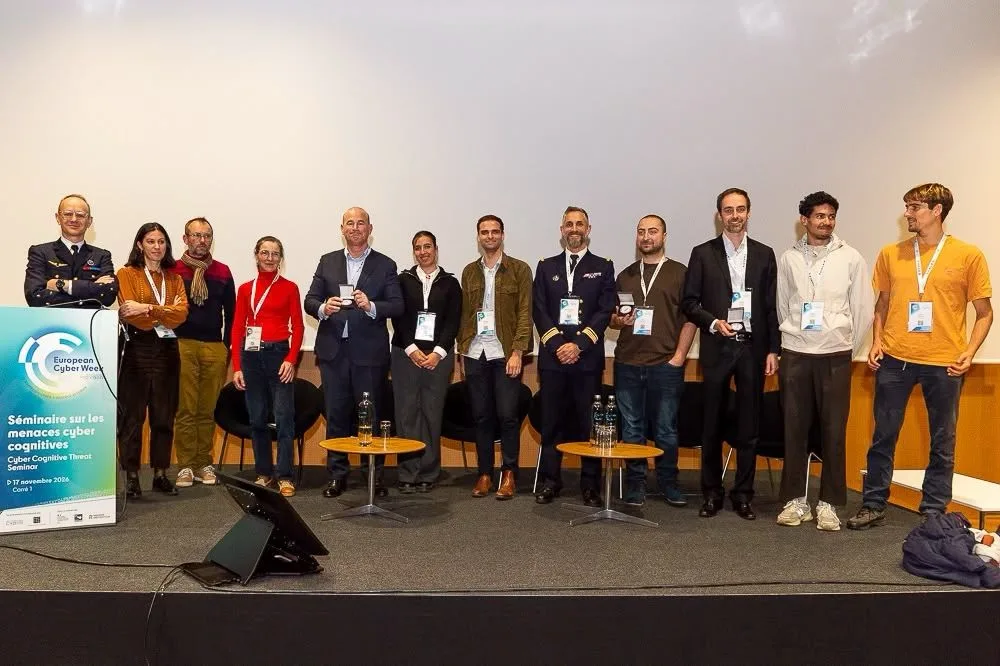
The results were presented on November 17, 2026 at the European Cyber Week, Rennes, during the Cyber Cognitive Threat Seminar, where the winners received their awards:
Available via API or on-premise
Our AI-generated content detection models and Deepfake detection models are available through our API:
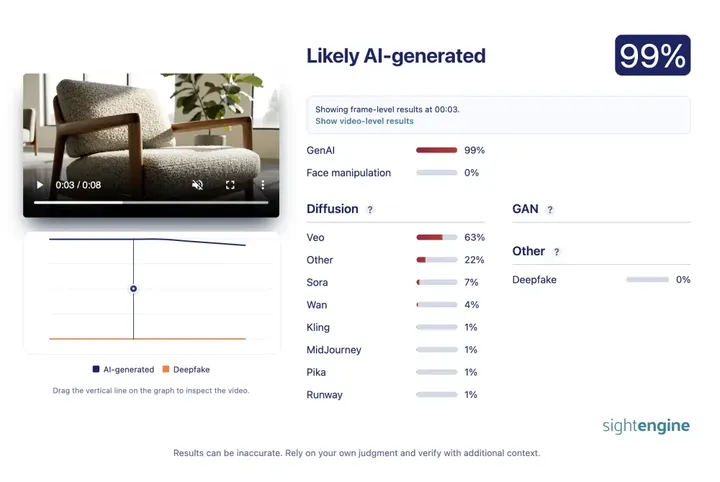
- AI-generated video detection: detects videos generated with models such as Sora, Veo, Kling, Runway, Pika and more
- Deepfake detection: detects faces that have been swapped or manipulated to impersonate another person
- AI voice detection: detects synthetic or cloned speech in audio tracks
- Lip-sync detection: available to select partners as a research preview
Videos are analyzed segment by segment, so you can flag a whole video or locate the manipulated segments within a longer clip. Stored videos, short clips and live streams are all supported.
For select organizations with strict security or sovereignty requirements, the models can be deployed on-premise, within your infrastructure. Contact us to discuss on-premise deployment options.
FAQ
Which is the best deepfake detector according to this benchmark?
In this deepfake detection benchmark, organized by the French Ministry of Defence on 40,000 unseen videos, Sightengine ranked first with an AUC-ROC of 0.978. The next best participants were Storyzy (0.925) and Label4AI (0.876), and the best commercial solution tested by the organizers was Resemble AI (0.941).
What does the AUC-ROC measure?
The AUC-ROC (area under the ROC curve) measures how well a detector separates real videos from manipulated ones, across all possible decision thresholds. A perfect detector scores 1.0 and random guessing scores 0.5. As it does not depend on choosing a particular threshold, it is a fair and robust way to compare detectors.
Was the evaluation independent?
Yes. The organizers built the dataset and kept its labels. Participants had never seen the 40,000 videos, so no system could have been trained on them: they only submitted a score for each video, and the organizers computed the results.
Which types of manipulation did the benchmark cover?
Fully AI-generated videos, face swaps with voice cloning, lip-sync dubbing, AI avatars and localized AI edits, produced with 47 platforms and generators, in 50 languages and 12 resolutions, with evasion techniques such as re-encoding, compression, blurring and added noise.
How can I use Sightengine's deepfake detection?
Sightengine's AI-generated video and deepfake detection models are available through the Genai API, the Deepfake API and the Speech API and can be deployed on-premise for select organizations.
About Sightengine
Sightengine builds Safety & Authenticity AI. In 2013, we launched the first AI-based API for content moderation, and have since expanded to broader Trust & Safety needs.
We have also been a pioneer in AI content detection, launching AI image detection in 2023, AI video detection in 2024 and AI audio detection in 2025.
Our models are proprietary, built and trained in-house, and analyze billions of images, videos, texts and audio files in real time for hundreds of organizations worldwide. Sightengine is headquartered in Paris, France.
Read more

Introducing Image Recapture Detection: Spot Photos of Photos
Detect images that were re-photographed from a screen or print. One API call to verify whether a photo is an original capture or a recapture.
Introducing Sightengine Detect: AI Content Verification Without Code
A no-code dashboard for journalists, T&S teams and investigators to verify AI-generated images, video and audio with drag-and-drop simplicity.